


Page 149 - Book_Artelia_10years
P. 149
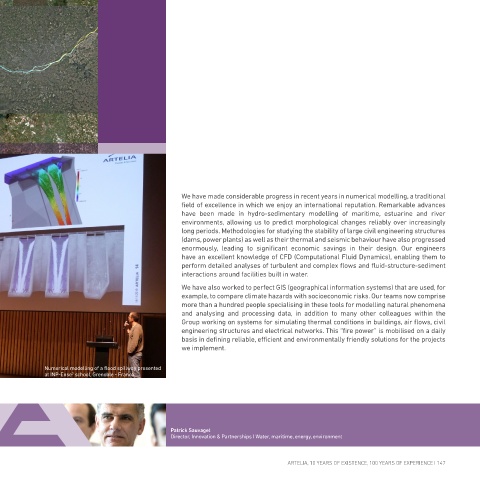
We have made considerable progress in recent years in numerical modelling, a traditional
                                               field of excellence in which we enjoy an international reputation. Remarkable advances
                                               have been made in hydro-sedimentary modelling of maritime, estuarine and river
                                               environments, allowing us to predict morphological changes reliably over increasingly
                                               long periods. Methodologies for studying the stability of large civil engineering structures
                                               (dams, power plants) as well as their thermal and seismic behaviour have also progressed
                                               enormously,  leading  to  significant  economic  savings  in  their  design.  Our  engineers
                                               have an excellent knowledge of CFD (Computational Fluid Dynamics), enabling them to
                                               perform detailed analyses of turbulent and complex flows and fluid-structure-sediment
                                               interactions around facilities built in water.
                                               We have also worked to perfect GIS (geographical information systems) that are used, for
                                               example, to compare climate hazards with socioeconomic risks. Our teams now comprise
                                               more than a hundred people specialising in these tools for modelling natural phenomena
                                               and  analysing  and  processing  data,  in  addition  to  many  other  colleagues  within  the
                                               Group working on systems for simulating thermal conditions in buildings, air flows, civil
                                               engineering structures and electrical networks. This “fire power” is mobilised on a daily
                                               basis in defining reliable, efficient and environmentally friendly solutions for the projects
                                               we implement.


            Numerical modelling of a flood spillway presented
            at INP-Ense  school, Grenoble - France
                   3


                                            Patrick Sauvaget
                                            Director, Innovation & Partnerships I Water, maritime, energy, environment


 146 I ARTELIA, 10 YEARS OF EXISTENCE, 100 YEARS OF EXPERIENCE            ARTELIA, 10 YEARS OF EXISTENCE, 100 YEARS OF EXPERIENCE I 147

