


Page 99 - Book_Artelia_10years
P. 99
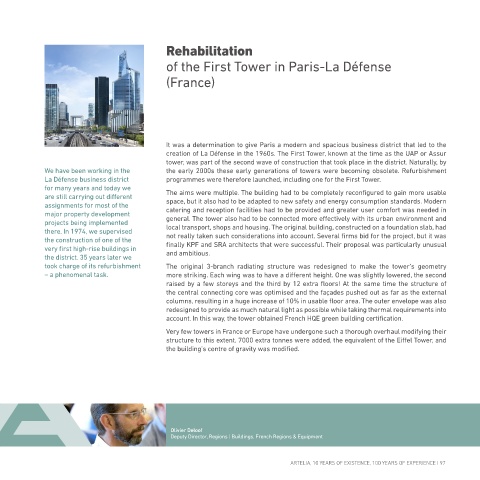
Rehabilitation
                                           of the First Tower in Paris-La Défense

                                           (France)


                                           It was a determination to give Paris a modern and spacious business district that led to the
                                           creation of La Défense in the 1960s. The First Tower, known at the time as the UAP or Assur
                                           tower, was part of the second wave of construction that took place in the district. Naturally, by
            We have been working in the    the early 2000s these early generations of towers were becoming obsolete. Refurbishment
            La Défense business district   programmes were therefore launched, including one for the First Tower.
            for many years and today we
            are still carrying out different   The aims were multiple. The building had to be completely reconfigured to gain more usable
            assignments for most of the    space, but it also had to be adapted to new safety and energy consumption standards. Modern
            major property development     catering and reception facilities had to be provided and greater user comfort was needed in
            projects being implemented     general. The tower also had to be connected more effectively with its urban environment and
            there. In 1974, we supervised    local transport, shops and housing. The original building, constructed on a foundation slab, had
            the construction of one of the   not really taken such considerations into account. Several firms bid for the project, but it was
            very first high-rise buildings in   finally KPF and SRA architects that were successful. Their proposal was particularly unusual
            the district. 35 years later we   and ambitious.
            took charge of its refurbishment   The original 3-branch radiating structure  was redesigned to make the tower’s geometry
            – a phenomenal task.           more striking. Each wing was to have a different height. One was slightly lowered, the second
                                           raised by a few storeys and the third by 12 extra floors! At the same time the structure of
                                           the central connecting core was optimised and the façades pushed out as far as the external
                                           columns, resulting in a huge increase of 10% in usable floor area. The outer envelope was also
                                           redesigned to provide as much natural light as possible while taking thermal requirements into
                                           account. In this way, the tower obtained French HQE green building certification.
                                           Very few towers in France or Europe have undergone such a thorough overhaul modifying their
                                           structure to this extent. 7000 extra tonnes were added, the equivalent of the Eiffel Tower, and
                                           the building’s centre of gravity was modified.


                                            Olivier Deloof
                                            Deputy Director, Regions | Buildings, French Regions & Equipment


 96 I ARTELIA, 10 YEARS OF EXISTENCE, 100 YEARS OF EXPERIENCE              ARTELIA, 10 YEARS OF EXISTENCE, 100 YEARS OF EXPERIENCE I 97

